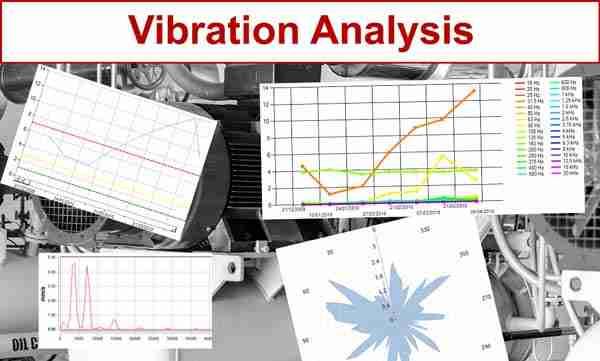
Vibration Study and AnalysisSuccessful vibration diagnosis requires a skilled and knowledgeable team. While trained technicians can perform standard data collection tasks, interpreting and analyzing vibration data demands the expertise of qualified engineers. These professionals must possess a strong understanding of mathematics, mechanical design, dynamics, and signal processing, and be capable of applying that knowledge to real-world industrial systems.Why is Vibration Study and Analysis Important?Vibration analysis is one of the most powerful diagnostic tools in predictive maintenance programs. It provides valuable insight into the mechanical health of machinery by studying vibration signals that reveal early signs of faults.By detecting issues at an early stage, vibration analysis helps prevent unexpected failures in critical components such as shafts, bearings, rotors, couplings, and motors. Common mechanical issues identified through vibration analysis include:Unbalance or misalignmentBent shaftsBearing or gear defectsLooseness or resonanceRotor rub and eccentricityBelt and pulley faultsFluid-film bearing instabilityKey benefits of vibration study and analysis include:Reduction in equipment repair and replacement costsDecrease in labor and downtime costsImproved production uptime and reliabilityEnhanced operational safetyIncreased machine efficiency and lifespanObjectives of Vibration Study and AnalysisA vibration study is typically conducted with one or more of the following objectives:Capacity Optimization:Evaluate the machine’s dynamic behavior across different operating speeds to prevent future issues and optimize performance.Rebuild Assessment:Determine how mechanical modifications or rebuilds affect the vibration characteristics of the system.Troubleshooting:Identify and eliminate vibration sources that negatively impact machine performance or product quality.Principles and TechniquesModern vibration analysis is performed using mathematical transformations, primarily the Fourier Transform, which decomposes complex vibration signals into their frequency components. This allows engineers to isolate specific frequencies linked to mechanical faults.The Discrete Fourier Transform (DFT) and Fast Fourier Transform (FFT) are standard computational techniques used in vibration analyzers to convert raw time-domain data into frequency spectra, enabling precise fault detection and diagnosis.How is Vibration Study and Analysis Performed?1. Raw Time Waveform AnalysisEvaluates vibration signals in their original time domain to identify issues such as impacts, looseness, or gear defects. This method is particularly effective for detecting impulsive vibrations.2. Spectrum Analysis (FFT)Converts time-domain data into frequency components, allowing engineers to pinpoint the source of a specific fault, such as imbalance or bearing wear.3. Speed Trials and Waterfall PlotsAnalyzes vibration amplitude as a function of machine speed or load using 3D waterfall graphs to identify resonances and critical frequencies.4. Impact TestingDetermines the natural frequencies of machine components like rolls, shafts, and drive systems, aiding in resonance detection.5. Synchronous AveragingIsolates the vibration signature of specific rotating elements using tachometer-triggered data synchronization.6. Operating Deflection Shape (ODS) AnalysisVisualizes how machinery deforms during operation at specific frequencies to identify excessive motion or weak structural zones.7. Finite Element Analysis (FEA)Simulates mechanical structures to predict their behavior under stress or modification and determine natural frequencies after design changes.Data Acquisition Techniques1. Online Data Acquisition and AnalysisContinuous monitoring of critical machinery using permanently installed sensors.Automatic data collection and alarm generation for early fault detection.Integration with database software for trend analysis and maintenance planning.Advantages:Continuous real-time monitoringImmediate fault detectionReduced operator involvementDisadvantages:High installation costRequires specialized setup and maintenance2. Portable Data Collectors and AnalyzersUsed for periodic inspections and field diagnostics. Available as single- or dual-channel units.Advantages:Records vibration spectra, waveforms, and trendsDetects abnormalities quicklySupports onsite analysisDisadvantages:Limited memory capacityRequires skilled operators3. Handheld Vibration MetersCompact and cost-effective tools for routine vibration checks by operators.Advantages:Easy to use and portableIdeal for quick, periodic monitoringDisadvantages:Limited analytical capabilityNo data storage or advanced diagnosticsBenefits of Vibration Study and AnalysisIdentifies the dynamic behavior of machine componentsDetermines mechanical health and maintenance needsEnables capacity enhancement and performance optimizationReduces unplanned shutdowns and production lossesImproves reliability and operational efficiencyProvides cost-effective maintenance and extended asset lifespanConclusionVibration study and analysis form the backbone of predictive maintenance strategies. By applying advanced diagnostic techniques such as FFT, ODS, and FEA, engineers can predict and prevent equipment failures, enhance safety, and maximize productivity. Partnering with a professional provider ensures that your vibration monitoring system delivers actionable insights and measurable results.